
Searching the Ordway Court Docket
Pull out the document that first brought the case to your door. A town summons should point to the municipal tribunal or its clerk. A state notice should name Crowley County Court or Crowley District Court. Ordway publishes no official municipal case-search or calendar portal. That gap does not mean your case is missing. It just means one thing. A phone call or written request to the town channel has to come first for an ordinance or municipal traffic matter.
- Read the issuing court, case or citation number, and appearance instructions.
- For an Ordway ordinance matter, contact the town clerk and ask for the current docket entry, date, place, and pay-or-contest method.
- For a state case, open the official Crowley Docket Search and select Crowley Combined Court.
- Use a date range plus at least one more filter, preferably the year, class, and sequence.
- Ask the proper clerk to confirm the setting before appearing or sending payment.
Treat the state search as a schedule rather than a full case history. A case with nothing coming up still has a file. Ask the Crowley Combined Court clerk for a Register of Action. It is often shortened to ROA. That document lays out the case in order. It can show minute orders, settings, and details that the public calendar leaves off. Keep the court label straight during any Ordway lookup. Town staff handle the municipal record. The state clerk handles Crowley County and District files. Write down which channel answered you, the date, and the exact record you asked for. That note pays off when a setting or order changes later.
Two Ordway Court Record Systems
Ordway serves as the county seat. That makes the two local-looking systems easy to mix up. Ordway Municipal Court handles the town's own ordinance and municipal traffic matters. Crowley Combined Court, also in Ordway, houses both Crowley County Court and Crowley District Court. It handles state cases. A street address alone will not settle which record system applies. The issuing authority and the case class will.
| Record channel | Matters covered | Best first step |
|---|---|---|
| Ordway municipal records | Town ordinances and municipal traffic | Read the summons and contact the town clerk |
| Crowley County Court | Misdemeanors, state traffic, small claims, evictions, county civil | Search the state calendar or call the combined clerk |
| Crowley District Court | Felonies, major civil, domestic, juvenile, probate, mental health | Search District events, then request the ROA |
A municipal code page is not a case docket either. It can describe the court's legal design and the town's rules, but it will not reveal whether a named case is set or resolved. Every Ordway docket lookup turns on that distinction. The split plays out in practical terms. An Ordway ordinance number points toward the town. A state class code points toward Crowley Combined Court. If neither clue is clear, ask the issuing office to identify the right record holder before filing a copy request. Ordway is both a town and the home of the state courthouse. Even so, a town case is not a state case. The summons, the case class, and the named clerk are your best route markers. Keep all three before choosing a channel.
Ordway Municipal Court Basics
Ordway's officially hosted code declares its municipal court a qualified court of record. The code requires a verbatim electronic or stenographic record. It also requires a judge who is a Colorado-licensed attorney. Being a court of record means the proceedings get a formal account. That matters when a party later needs to review what happened. It also matters for instructions about appellate review. The town posts no current municipal session calendar, judge listing, case portal, or caseload report. Leave those gaps alone. Ask the town clerk directly. Ask whether your matter is on a municipal docket, when the next session occurs, who keeps the file, and how to get the docket or disposition. Written instructions from the clerk should control over old code text or an uncited third-party listing. Details should come from the current record itself. A code rule can define authority. Only the docket, an order, or clerk confirmation can show the status of one municipal matter. Frame any request with precision. Name Ordway, cite the Ordway citation number, and specify the exact record wanted. Ask whether the clerk can provide a public docket, a disposition, or a signed order. Focused wording lets staff answer without reading the request as a broad county search.
Ordway Docket Record Since 1988
Ordway Ordinance 399, adopted in 1988, added an unusual chapter to local court history. It declared the court a qualified court of record. A verbatim record was also required. That rule separates Ordway from towns where municipal proceedings follow a different record model. It also explains the review path. Anyone seeking review should ask for the formal record and current appeal instructions rather than expecting a fresh trial by default. The official municipal-court code provisions lay out this structure on the town's hosted code channel.
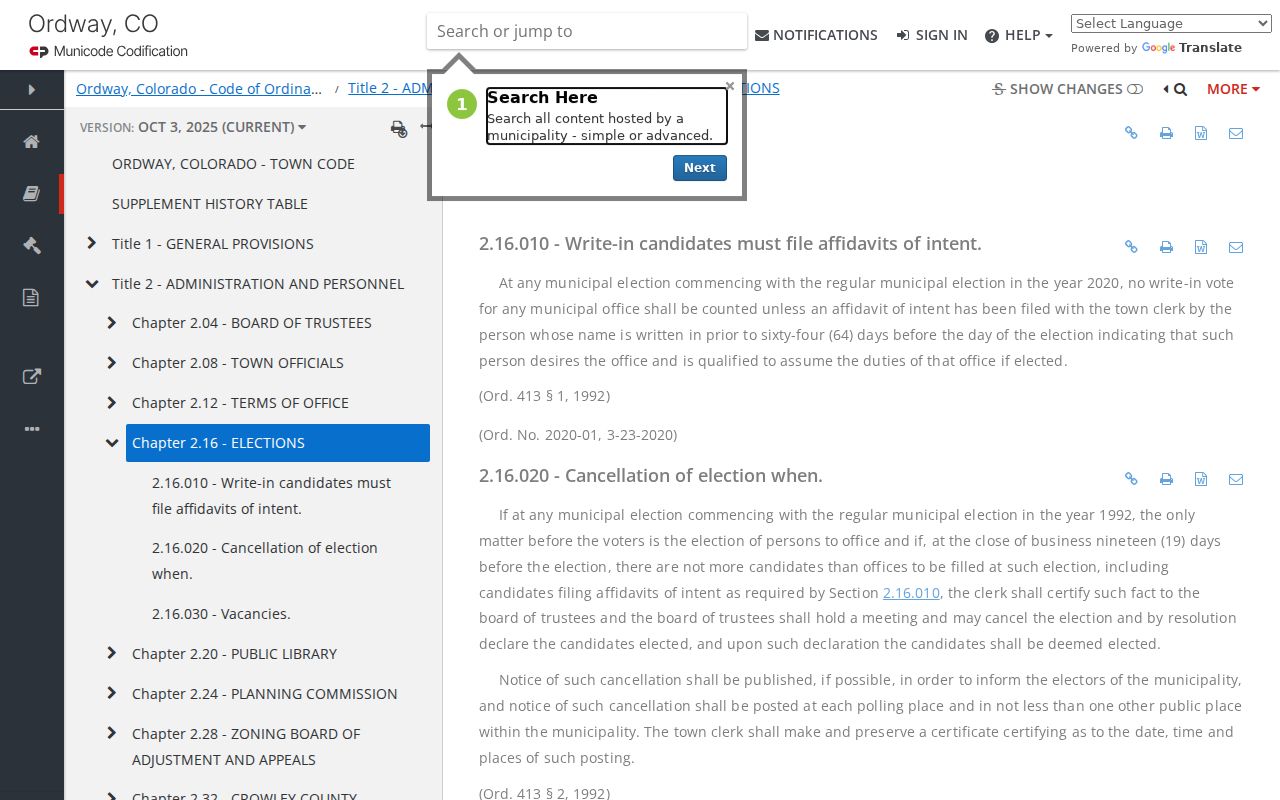
The preserved code is useful context. Still, a live Ordway docket, hearing date, and copy procedure all come from the current clerk. The 1988 rule gives Ordway a distinct record history. It does not freeze modern procedure. Present-day staff must confirm how a record is made, stored, copied, and used for review. Read the code and the live docket together.
Court Dates and Settings in Ordway
Need your court date? For an Ordway municipal setting, trust the summons and confirm directly with the town, which posts no public calendar of its own. State settings at Crowley Combined Court are easier to check. The Colorado Docket Search lists the date, time, duration, hearing type, location, appearance type, courtroom, case number, and displayed case name for each event. Match the case number, not the name. A similar name alone proves nothing.
| Date | The current event date; compare it with the newest notice or order. |
|---|---|
| Time | The scheduled start, not a promise of the exact time the matter will be called. |
| Courtroom | The room assigned to a state event; confirm municipal location directly. |
| Appearance | In person or another authorized mode shown for that specific event. |
| Setting Type | Examples include advisement, status conference, pretrial, or another listed hearing. |
A reset only counts when the court grants it. A request alone moves nothing. If an old paper notice disagrees with the current online event, call the custodian listed on the notice. Write down what the clerk confirms. That note can save you later.
For a municipal date, ask whether a new written notice will issue. For an Ordway state date, double-check the appearance type and courtroom on the current event. Both checks keep you from relying on a stale Ordway setting.
Ordway Code Search Is Not Docket Search
The official Ordway Code of Ordinances offers simple and advanced search. Navigation, printing, downloads, and email tools come with it. Handy as those are, they search enacted town law. They will not surface defendants, citations, settings, warrants, pleas, or dispositions in municipal cases. The official code page shows the town's legislative text. It can help you locate the ordinance named on a summons. A live case inquiry still goes to the municipal clerk.
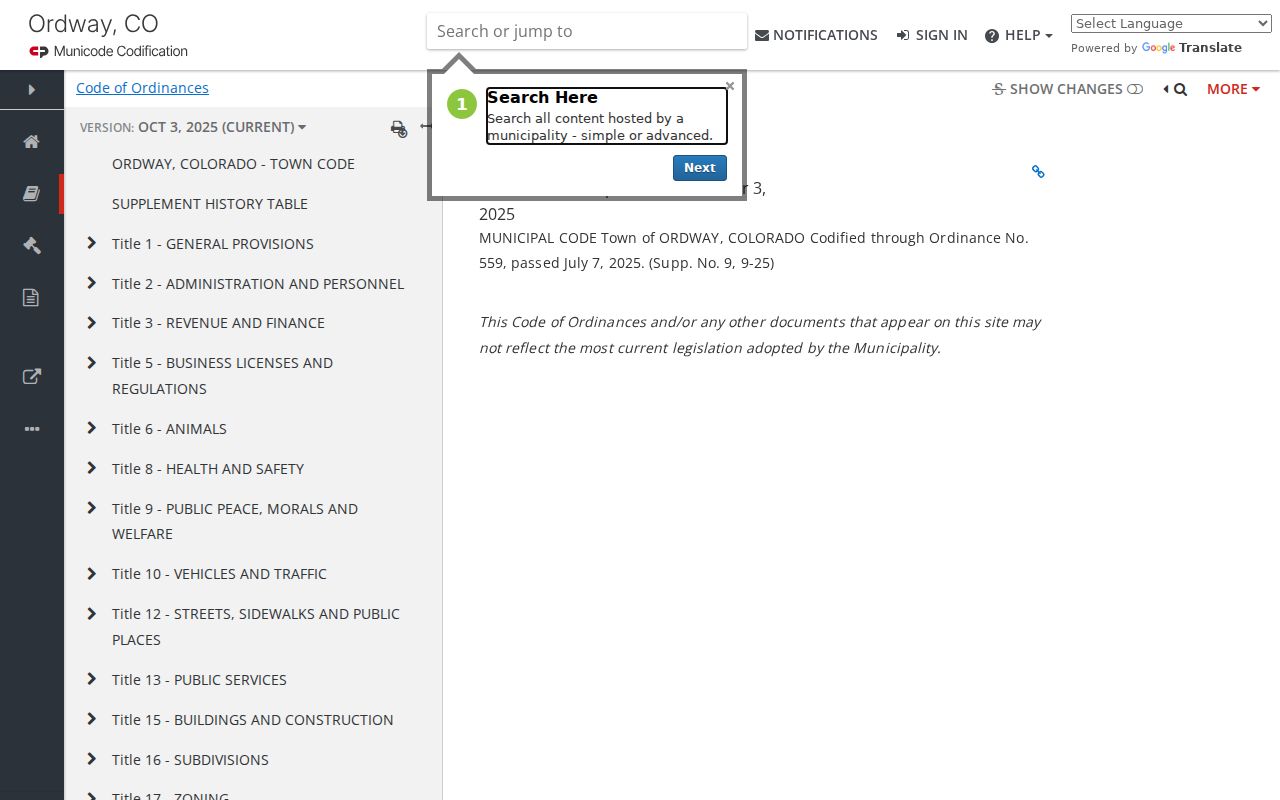
Use the code to understand the rule. Use the court record to learn what happened in one case. Mixing the two invites false conclusions about a date, a charge, or an outcome.
A code question calls for searching Ordway's legislative text. A case question calls for requesting the Ordway judicial record. If an Ordway result shows up in neither place, contact the Ordway custodian. Confirm the number, status, and next Ordway setting.
Traffic Tickets in Ordway
Before any docket search, read the court line on the citation. A state traffic case in Crowley County Court commonly uses class T. It may appear in the statewide hearing calendar. A ticket filed under Ordway's municipal code belongs to the town's record keeper instead. It may not appear in county-filtered state results. One road incident, two search routes, depending on the issuing law.
For a state ticket, search with Crowley County, County Court, and a suitable date range. Add the year, T class, and sequence if known. For a town ticket, ask the Ordway clerk about citation status and the current setting. Ask about the approved pay-or-contest process too. The Crowley County traffic ticket record page covers state T cases and the official state payment channel.
Ordway Docket Fees Need Confirmation
What does the Ordway code publish? A $10 surcharge when an imposed fine is below $70. A $15 surcharge applies above $70. The code also lists a $25 time-payment fee. A $15 late-payment fee appears there too. Treat these as code-based figures, not a quote for your case. A current resolution, order, or case status can change what is due.
Always confirm the total and payment method with the municipal clerk. Keep in mind that payment can itself be a case disposition choice. Never send money based on a code search alone. Ask whether an appearance is required and whether a pending warrant or order needs separate action.
Tie every Ordway amount to the current Ordway case. A published fee does not state your balance. Ask the clerk for the charge, due date, approved channel, and whether the Ordway court requires an appearance.
Where Ordway Cases Go
Municipal ordinance matters start in Ordway's own record channel. State misdemeanors and traffic matters go to Crowley County Court. Felonies, major civil matters, domestic relations, juvenile cases, probate, and mental-health matters sit elsewhere. They land on the Crowley District Court side. The two state courts share the Crowley Combined Court clerk. Each keeps its own jurisdiction and case classes.
Docket flow: Ordway Municipal Court › Crowley County Court › Crowley District Court
An appeal or transfer can leave records at more than one level. Ordway is a court of record, so when review is at issue, request the verbatim municipal record and current appeal instructions. For a state case, the Crowley County case lookup can find an upcoming event before you order a full ROA.
Ordway State Dockets in Room 303
State records live at Crowley Combined Court, in the Crowley County Courthouse. The address is 110 East 6th Street, Room 303, Ordway, CO 81063. The clerk answers at 719-267-4468 and takes faxes at 719-267-3753. Public hours run Monday through Friday. The windows are 8:00 a.m. to noon and 1:00 to 4:00 p.m. Note the midday gap. The office closes from noon to 1:00 p.m.
Crowley Combined Court
110 East 6th Street, Room 303
Ordway, CO 81063
719-267-4468
State County and District Court records only. Municipal Ordway files remain a separate town matter.
Driving in from a rural area? Call first if you need an older file, same-day certification, or a public terminal. The official location page makes no promise about terminal availability. Off-site retrieval may carry real cost.
One building serves both state County and District records. Yet each request must still name the right side. Bring the Ordway-linked state case number. Ask whether the file is on site. Confirm when your copy will be ready.
Ordway Court Record Access Rules
Which clerk you ask depends on where the case lives. A state case belongs to the Crowley Combined Court clerk. That clerk follows Colorado Judicial Branch access rules, Chief Justice Directive 05-01 among them. Town matters are different. Start with the Ordway custodian. Spell out exactly what you need, whether that is the municipal docket, a disposition, or a verbatim record. If protected information blocks a full release, request a public or redacted version instead.
Key rules:
Colorado Judicial Branch access guidance distinguishes court case records from ordinary agency files and directs requesters to the proper court channel.
Colorado Open Records Act overview describes the broad public-record framework, while judicial case files follow judiciary-specific access rules.
Not everything in a court file is open. Sealed, suppressed, juvenile, probate, and protected material can all be limited. An eligible requester may have to show identification. Yet ID alone does not create a right of access. And when a public search comes back blank, it may simply mean no future hearing falls in the selected range.
No Ordway Docket Result
A failed search calls for a channel check, not a guess. First confirm whether the matter is municipal or state. Then check spelling, court type, year, class, sequence, and date range. The state calendar also demands one filter beyond the date. A missing filter can look like a missing case. If the screen stays blank, call the right clerk. Say plainly whether you need a setting, an ROA, a disposition, a certified copy, or an older file.
For state records, use the official Record/Document Request Form. It accepts party information, a case number when known, and the filing year. It also takes the county and your document choices. Select Crowley and pick Register of Action/ROA for the full case chronology. A town case works the other way: request the municipal docket or disposition directly. Skip the unofficial people-search services either way.
Keep an Ordway no-result check tied to Ordway facts. Recheck the Ordway court name, the Ordway number, the Ordway date, and the Ordway custodian. Ask whether the Ordway file is municipal or state. Then write down the Ordway answer and your next Ordway step.